

Rx 5500 Xt Vs 1660 Super
AMD Radeon RX 5500 XT vs. Nvidia GeForce GTX 1660: The Battle for Mainstream Gaming Supremacy
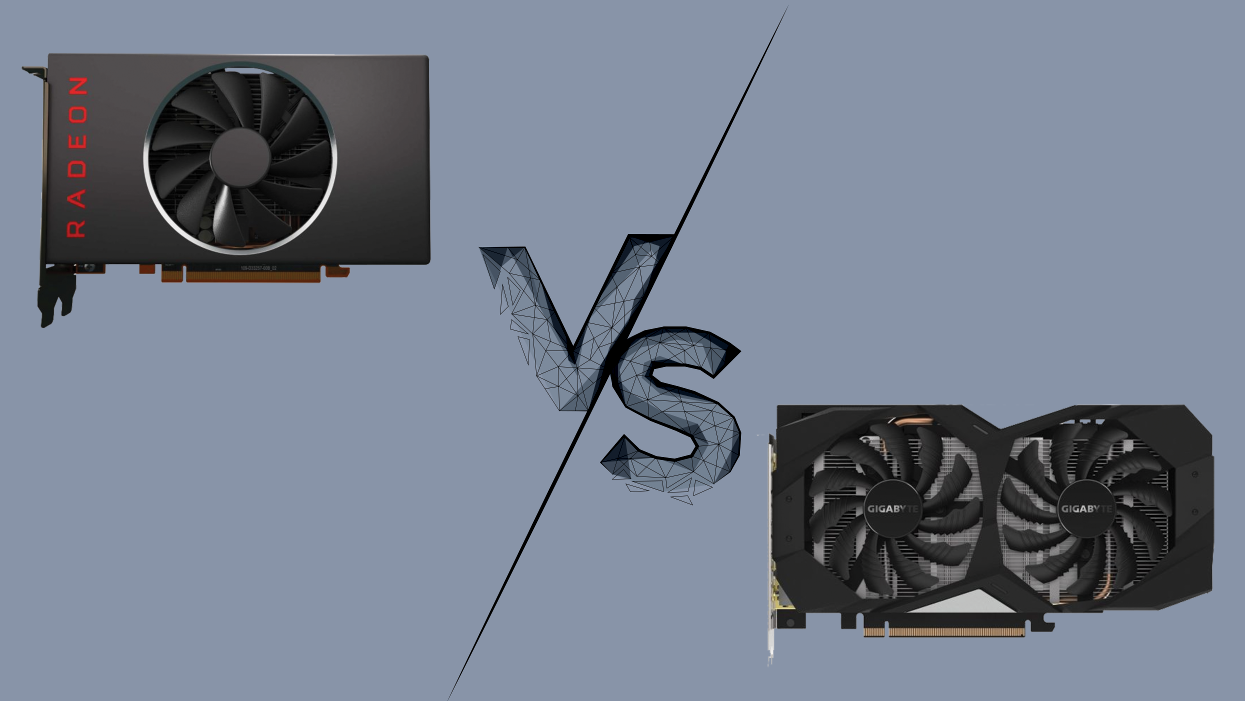
AMD recently launched the Radeon RX 5500 XT, which aims to capture the attending of mainstream gamers with a mid-range upkeep to spend on a GPU. Following our review, we already know it's not every bit powerful as Nvidia'south GeForce GTX 1660, but tin information technology offering enough value to make up for what it lacks in performance? Allow's observe out.
It's an exciting time to be in the market for a new GPU, with several new products on the market in the concluding 12 months. Concluding year at this time, gamers were eagerly awaiting the reveal of AMD's Navi compages and the new line of GPUs that would reinvigorate the visitor's Radeon Graphics brand. And Nvidia had not yet launched the RT and Tensor core-free 16-series Turing GPUs for the mid-range market.
Today, we've got myriad options from team red, including the recently launched Radeon RX 5500 XT, which introduces Navi to the loftier-book segment of the market, in the $200 price range. AMD is no stranger to this toll point. For several generations, the Radeon squad has focused its attending on mainstream cards like the RX 480, 580, and 590 (all based on the same Polaris compages).
However, Nvidia'southward GeForce GTX 1660, which striking store shelves in March of 2019, is a stiff contender for your gaming coin. That GPU's successor, the GTX 1660 Super, is somewhat more than expensive ($230+), only the original model is still readily bachelor and often sells for $210 or less.
Now the question becomes, which card should you lot cull if y'all're in the market for a new GPU for roughly $200. We compared the features and benefits of the Radeon RX 5500 XT and the GeForce GTX 1660 in four categories -- featured engineering, game operation, power consumption & rut output and Value -- to aid you decide which of these two cards is right for you.
Featured Technology
AMD'southward NAVI 14 XTX GPU features the same number of cores (1408) as the version of Nvidia's Turing TU116-300-A1 chip found in the GTX 1660. Although it operates at a higher frequency and produces higher peak floating-point performance (five.2 TFLOPS vs the GTX 1660's 5 TFLOPS).
AMD's NAVI 14 XTX features 6.four billion transistors, which is 200 million fewer than the Turing TU116, merely AMD crammed its chip into a much smaller packet. Cheers to TSMC's 7nm finFET process, AMD's GPU fits on a 158 mm² dice. Turing GPUs are also manufactured on TSMC'due south finFET procedure, but Nvidia is working with a larger 12nm procedure. As a result, the TU116-300-A1 is nearly twice the size of NAVI fourteen XTX at 284 mm².
The RX 5500 XT likewise offers faster GDDR6 memory compared to the GTX 1660's GDDR5 retentiveness modules. Nvidia does provide a larger 192-bit retentiveness bus versus AMD's 128-bit retention bus configuration, but the faster retention more than than makes upwards for the difference in motorcoach size. Theoretically, the NAVI xiv XTX has 224 GB/s of memory bandwidth to work with, compared to the 192 GB/south that TU116 offers. The Radeon RX 5500 XT is available in 4GB and 8GB configurations. But for this comparison, nosotros're focusing on the 8GB version. The GeForce GTX 1660 falls right in the middle, with 6GB of graphics memory.
By the numbers, AMD'south RX 5500 XT appears to be the stronger of the two GPUs. Information technology's manufactured on a smaller, more than efficient process, offers a college base of operations and boost clock speed, and has a higher theoretical performance limit. The higher capacity of faster GDDR6 memory likewise gives information technology a pregnant reward.
| | Gigabyte RX 5500 XT Gaming OC 8G | Gigabyte GeForce GTX 1660 OC 6G |
|---|---|---|
| Architecture (GPU) | RDNA (Navi 14 XTX) | Turing (TU116) |
| ALUs/Stream Processors | 1408 | 1408 |
| Summit FP32 Compute (Based on Typical Heave) | 5.2 TFLOPS | five TFLOPS |
| Tensor Cores | N/A | Due north/A |
| RT Cores | N/A | N/A |
| Texture Units | 88 | 88 |
| ROPs | 32 | 48 |
| Base Clock Charge per unit | 1685 MHz | 1530 MHz |
| Nvidia Boost/AMD Game Rate | 1737 MHz | 1785 MHz |
| AMD Boost Rate | 1845 MHz | Due north/A |
| Memory Capacity | 8GB GDDR6 | 6GB GDDR5 |
| Memory Bus | 128-bit | 192-flake |
| Retentivity Bandwidth | 224 GB/due south | 192 GB/s |
| L2 Enshroud | 2MB | 1.5MB |
| TDP | 130W | 120W |
| Transistor Count | six.4 billion | 6.6 billion |
| Die Size | 158 mm² | 284 mm² |
AMD offers a multifariousness of software features for the Radeon RX 5500 XT. The company's Radeon Software allows you to monitor your GPU's temperature, fan speed and voltage, adapt the graphics settings for your games, admission performance reports and game states, and update your GPU drivers. The Radeon Software Adrenalin 2020 edition also lets launch games directly from the Radeon Software dashboard. It even offers integrated media capture and game streaming features, including screenshots, video, and instant gif capture besides as compatibility with many popular streaming services such equally Twitch, YouTube, Mixer, Facebook and more than.
AMD also offers a feature chosen Game Heave, which monitors your framerate and dynamically adjusts the resolution of your games when information technology won't impact the visual experience to maximize performance.
The Radeon RX 5500 XT likewise supports a technology called Radeon Anti-Lag, which aims to reduce input lag by managing the queue of work sent to the CPU and ensuring that the CPU can't get alee of the GPU. Also, Radeon Image Sharpening combines contrast-adaptive sharpening with GPU upscaling to produce crisper in-game visuals.
Nvidia'south GeForce Feel software is a reasonable equivalent to AMD's Radeon Software Adrenalin. It enables you lot to proceed your drivers up to appointment, offers performance-optimized game setting configurations, and allows you to launch your games from the GeForce Feel dashboard.
Nvidia'due south software supports media capture and game streaming features that integrate with popular streaming platforms. The GeForce GTX 1660 takes total advantage of Nvidia's NVENC hardware encoder technology (opens in new tab), which lowers the CPU overhead associated with software encoding. NVENC allows the CPU to send a single set of instructions to the GPU, which the GPU uses to output to your display and broadcast without impeding performance.
GeForce Experience also includes Nvidia's advanced screenshot capture technology, called Nvidia Ansel, which allows you to capture extremely high-resolution (upward to 33x 1080p) images of supported games. Ansel also offers complimentary-camera capture, which allows you to snap angles that aren't possible in-game, and the power to capture 360-degree images. Ansel even supports RAW EXR output, which allows y'all to brand changes to the epitome in postal service-processing, such equally create HDR-enhanced images.
Both AMD and Nvidia offer support for adaptive display technology. The Radeon RX 5500 XT supports both FreeSync and FreeSync 2, whereas the GeForce 1660 is compatible with Nvidia'due south more than-expensive M-Sync adaptive display engineering science. Nvidia besides supports a select few FreeSync displays. And as for functioning, both AMD and Nvidia offer dynamic clock speed boosting technologies that automatically overclock your GPU to maximize the capabilities of your hardware configuration.
Winner: Tie. Both AMD and Nvidia offer compelling feature sets for their upkeep-minded options. Each card supports automatic game optimization, game streaming, and driver update software. And they both back up performance optimization features that maximize your gameplay experience.
Gaming Operation
We tested xi relatively demanding games on both GPUs with maximum and medium settings enabled. In The Division 2, Gears of War 5, Strange Brigade, Far Cry 5, Shadow of the Tomb Raider, Final Fantasy XIV, Forza Horizon four and Battlefield V both cards managed to drive threescore fps average gameplay with the graphics settings maxed right out.
More than demanding titles such as Borderlands iii and Metro: Exodus, we had to driblet the settings to medium to achieve the coveted bare minimum of 60 fps. Ghost Recon: Breakpoint was also very demanding, and our Radeon was unable to crest fifty fps at max settings. However, the GTX 1660 fell just a sliver short with an average framerate of 58.7 fps on max settings.
Both cards produce adequate performance for 1080p gaming, merely the GeForce outshined the Radeon by a small margin in all but two of our tests (at medium settings), but the 2 that AMD won were by less than a 1% margin. The GTX 1660 oft held a five% or better atomic number 82 over the RX 5500 XT in our max settings tests.
Winner: Nvidia. Despite having the superior on-paper specifications and equivalent software features, in a competition of might, the GTX 1660 outperformed the RX 5500 XT in virtually every examination we threw at these two cards. Nvidia's configuration appears much more capable of handling games with maximum graphics settings enabled than AMD's. Strangely, the RX 5500 XT is a stronger competitor with medium settings, but why would y'all settle for medium if yous don't need to?
Ability Consumption and Heat Output
On the budget end of the GPU market, ability consumption shouldn't really be much of business concern. None of the GPUs of this calibre draw anywhere nearly plenty power to brand a significant difference in your system's configuration. Both AMD and Nvidia recommend at least a 450-watt ability supply for their respective cards.
AMD'south Radeon RX 5500 XT features a TDP rating of 130w, whereas Nvidia'due south GeForce GTX 1660 includes a TDP rating of 120w. In practice, the Radeon GPUs actually draw quite a bit less than 130 watts, except under extreme loads. We tested ii examples of the RX 5500 XT, a 4GB Sapphire and an 8GB Gigabyte carte du jour, and nosotros found that, in-game, the AMD bill of fare will average close to 100w.
The Gigabyte GeForce GTX 1660 sample that we tested in March 2019 needed an average of 126 watts, and peaked at 134 watts, and the Zotac model that nosotros used in the Radeon RX 5500 XT review pulled betwixt 110 and 120 watts in our Metro: Exodus ability exam.
Interestingly, the Zotac GeForce GTX 1660 peaked around 100w in our Furmark stress test, whereas the Gigabyte sample drew around 130w for this examination. Both the Gigabyte and Sapphire Radeon cards topped 120w in this exam, with the Sapphire model touching 136w at its peak.
You likely won't be concerned with the power requirements for these cards, but higher power draw does equate to higher rut output, which is likely of higher concern to you lot.
Our Gigabyte RX 5500 XT OC 8G proved to be one of the coolest-running GPUs that we've seen in this segment. Post-obit three passes of our Metro: Exodus examination, the data showed that the GPU never exceeded 63C. Our tests with Gigabyte'southward GeForce GTX 1660 OC 6G showed that it peaked at a 68C. It's also worth noting that the fans on the GeForce were spinning at 2000 rpm, and the Radeon carte du jour spun at a leisurely 1800 rpm.
Winner: AMD. The power requirements for either of these cards is low enough to exist negligible. However, the depression oestrus output from the Radeon RX 5500 XT, likely aided by its smaller 7nm process, gives AMD a leg upward in this category.
Value Proposition
Comparing the value of the Radeon RX 5500 XT 8GB to the GeForce GTX 1660 is a somewhat challenging task. If you compare these cards at the same price, the GeForce GTX 1660 is the clear winner.
Nvidia'south offering outperforms the contest handily in gaming tests, which if we're honest is kind of the indicate of a graphics bill of fare—particularly in the $200 range. However, AMD's selection yet delivers acceptable performance and costs a few dollars less, which somewhat evens that playing field. Where the Radeon perchance 5% to ten% cheaper, it'southward also 5% to x% slower in many cases.
Winner: Nvidia. We can't call the Radeon RX 5500 XT a bad deal. It's far and away a better menu than you would have bought for the same cost a year ago. Yet, for but a few dollars more than yous can become better gaming performance from a GeForce GTX 1660.
| Round | Nvidia GeForce GTX 1660 6GB | AMD Radeon RX 5500 XT 8GB |
|---|---|---|
| Featured Technology | ✗ | ✗ |
| Gaming Performance | ✗ | |
| Ability Consumption | ✗ | |
| Value Proposition | ✗ | |
| Total | 3 | 2 |
Bottom Line
What a divergence a year can make. The last time we did a showdown of the mid-range GPUs, nosotros put the Radeon RX 590 toe to toe with the GeForce GTX 1060 and AMD'due south card was the definitive winner. This fourth dimension around, the tables have turned and Nvidia has captured the mid-tier crown dorsum from AMD.
But pricing is close and can always change. And then if you're reading this in the weeks and months after first publication (in mid-January 2020), brand certain to check your favorite online store to see if the value balance has shifted -- or if something better has come up along. Like most areas of PC tech, price cuts and new products are always coming along to change the boxing for your difficult-earned component dollars.
Source: https://www.tomshardware.com/features/amd-radeon-rx-5500xt-vs-nvidia-gtx-1660
0 Response to "Rx 5500 Xt Vs 1660 Super"
Post a Comment